The problem
Delta Solutions collects and transports waste for about 200 sites with a fleet of about 40 vehicles. Trips lived in Excel, backed by roughly 190 pages of scanned trip evidence every month, and a four-person team hand-built about 130 LEED waste-diversion reports of 30 to 35 pages each, all due in the first two days of the month. Every month the same deadline arrived with the same manual work behind it.
What we built
Trip logging with the evidence attached
Every trip is recorded against a site, a vehicle and a driver, with a photo of the service note. The system issues the electronic manifest serial itself, starting at E01, and warns when a serial repeats, so duplicates are caught at entry instead of at month-end.
A waste taxonomy with the rules written down
Each waste type carries its own calculation rules. Excavated soil and hazardous waste are recorded on the trip but excluded from every diversion percentage, because that is how the reports have to read. Those rules sit in code with tests behind them.
Monthly reports on one click
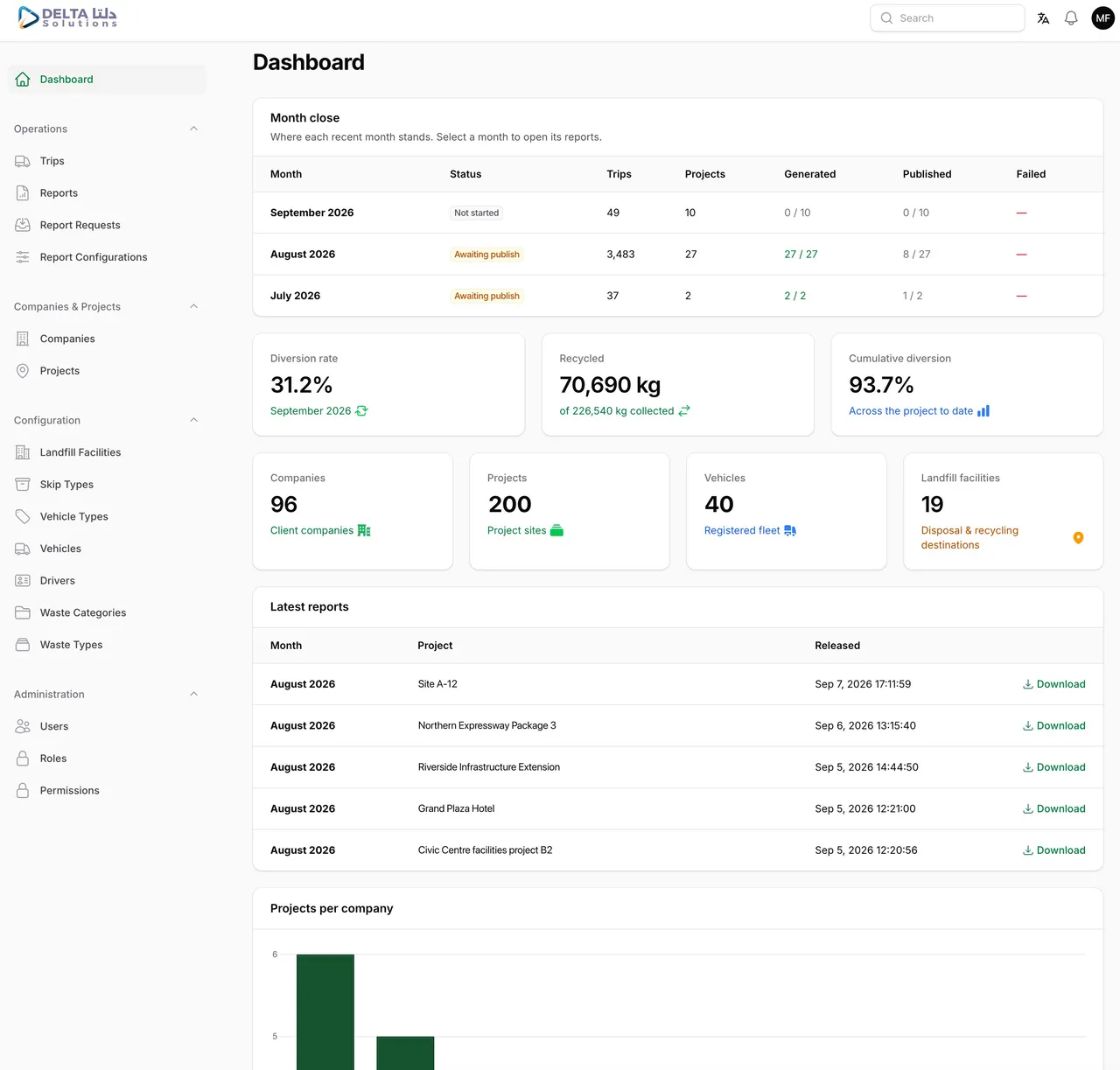
About 130 client reports a month are generated on a queue as Word and PDF with English and Arabic covers, alongside per-trip manifests. A month-close tracker shows which projects are complete and which are still missing trips.
Three kinds of account
Admins run the system. Employees enter data only for the projects they are assigned to. Clients log into a read-only portal and see their published reports, and in phase two they request new ones themselves.
The old spreadsheets, imported
Historical Excel logs were imported at launch, so the team started with its own history rather than an empty database. CSV exports go the other way for anyone who still wants a spreadsheet.
Screens
How we worked
We worked from the existing workflow rather than an org chart: the trip sheet, the scanned service notes and the report the client already sends out. Phase one was quoted as a fixed scope and delivered in about four weeks from kickoff. Phase two runs the same way, one agreed batch at a time.
Results
monthly reports generated on a queue
Previously hand-built by a four-person team, 30 to 35 pages each, due on the first or second of the month.
from kickoff to the first release
Fixed scope, quoted before any work started.
sites and about 40 vehicles tracked daily
Trips logged with photo evidence and automatic manifest serials.
test files across 155 PHP files
The calculation rules stay under test as the taxonomy changes.
What's next
Phase two adds client-initiated report requests, driver records, exports and email invitations. The panel stays bilingual and the calculation rules stay under test as new waste types arrive.